 GoldFynch Documentation
Redact information
The ability to redact sensitive material in produced documents is a common eDiscovery requirement. GoldFynch has made it possible to redact information without disrupting the flow of your document review by integrating the redaction tool directly into its Document Viewer.
Text and images you redact will be blacked out and unrecoverable in the final produced document (i.e., the document you give to opposing counsel). However, in your original file, the text will be visible and fully searchable. While redacting information, you can add redaction stamps to it, this will help identify the reason for the redaction.
Note: In native-only productions, if the document contains redactions, it will be produced in an image-only format.
Identifying your redactions with redaction stamps
Redaction stamps allow you to identify why a reviewer has redacted a portion of the file. While redacting, the reviewer can attach a small label, aka a stamp, with text like "Attorney Client Privilege", "Confidential", "Proprietary", "PII", etc., to explain the reason for the redaction. The redaction stamps that reviewers apply will be printed within the redaction boxes when your documents are produced.
Concepts and terms related to redaction stamps
Before we start adding redaction stamps to redactions, let's understand some key terms related to in GoldFynch.
-
Managed redaction stamps: A reusable redaction stamp that has been created ahead of time for the whole case. You can create these stamps in the
Case Settingsview. When creating the stamp, you can give it a name and an abbreviation (that can be used when the full name won't fit inside the redaction box). Learn more about creating and managing managed redaction stamps. -
One-off redaction stamps: A redaction stamp the reviewer creates on-the-fly while redacting, just for a particular reason or the user's reference. These stamps are not added to the case's managed redaction stamp list and do not have abbreviations. However, one-off / on-the-fly redaction stamps, once created, will be available to the user who created them for any document within the case.
-
Applying a redaction stamp: A reviewer can attach one or more redactions stamps to a single redaction while redacting itself. These redaction stamps could either be managed stamps or one-off stamps. Learn how you can apply redaction stamps to redactions and manage them.
-
Final vs Preview: When producing documents in "Final" mode, the production process will write the redaction stamp into the solid boxes over the redactions. When producing documents in "Preview" mode, the redaction stamp will not be applied over the see-through boxes, as "Preview" mode is meant for a quick look.
Marking content for redaction
Placing redaction boxes using the new document viewer layout
Step 1. Click on the Docs icon in the left navigation panel to open the Document Viewer.
Step 2. Select the New viewer option from the layout panel
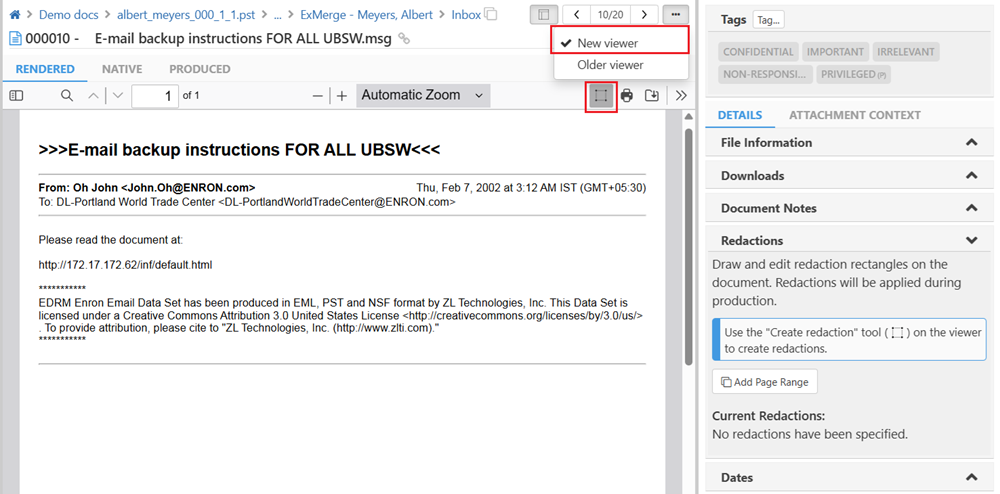
Note: The New viewer option is selected by default
Step 3. Scroll to the content you wish to mark for redaction.
Step 4. Click on the Draw button in the document viewer toolbar.
Step 5. Click and drag the mouse cursor to draw a box over the content to be redacted.
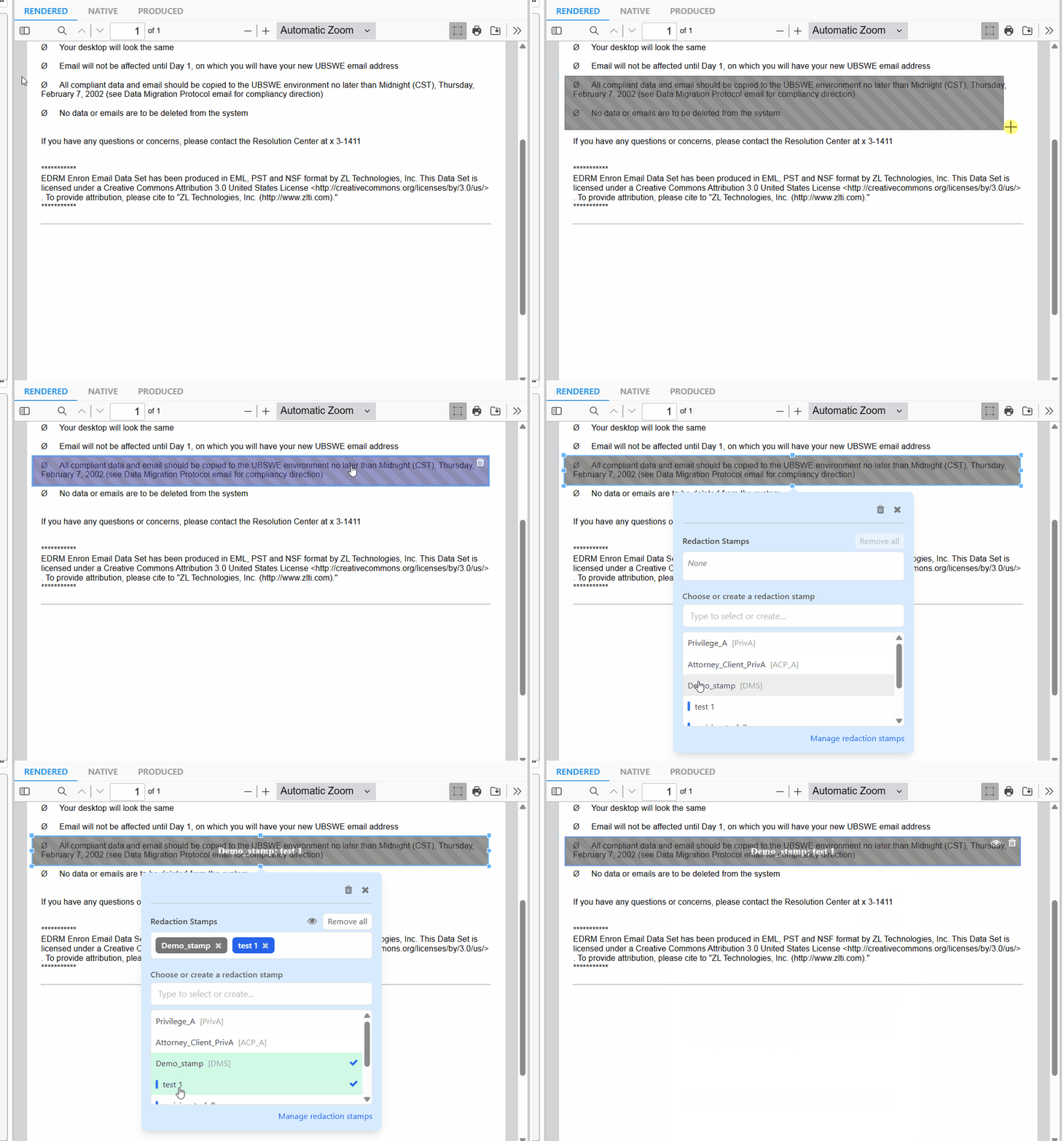
Step 6. (Optional) Click on the redaction box to view the redaction stamp pop-up box
Step 7. (Optional) Select a redaction stamp from the list or enter a one-off redaction stamp and then close the pop-up box
Repeat Steps 5-7 for all redactions you need to make, then deselect the 'Draw' button in the document viewer toolbar.
Learn more about adding and updating redaction stamps to redactions.
Placing redaction boxes using the old document viewer layout
Step 1. Click on the Docs icon in the left navigation panel to open the Document Viewer.

Step 2. Select the Older viewer option from the layout panel
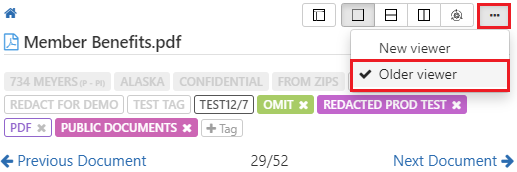
Step 3. Scroll to the content you wish to mark for redaction.
Step 4. Click on the Draw button in the right-side panel.
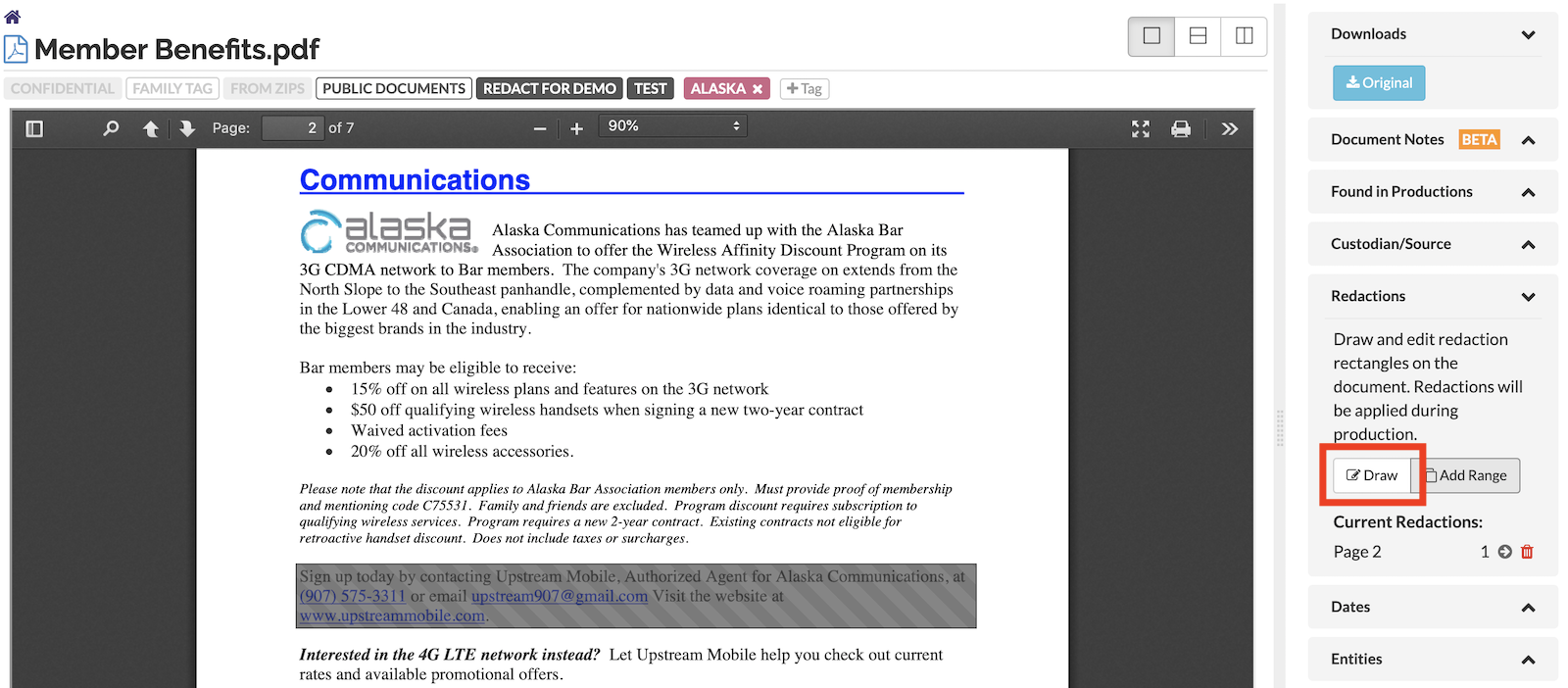
Step 5. Click and drag the mouse cursor to draw a box over the content to be redacted. Repeat this for all the content in the document that you wish to mark for redaction.
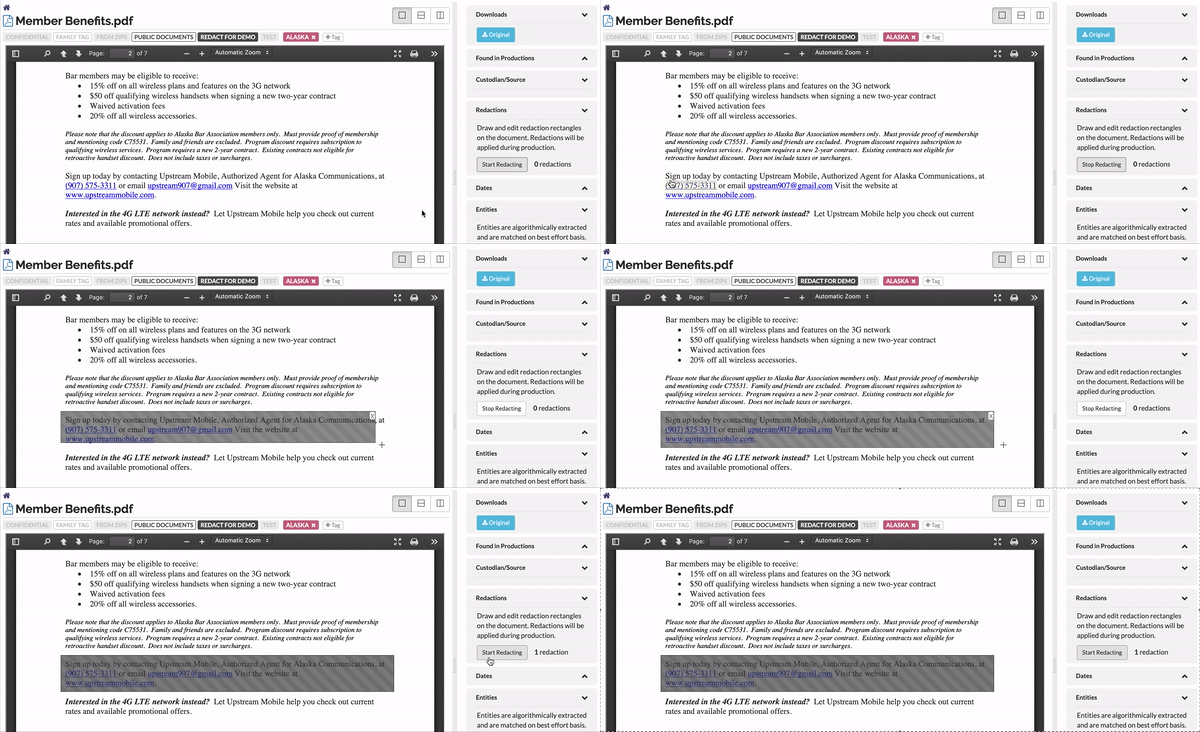
Step 6. Click on the Stop Redacting button to save your redaction box placement.
Note: You can apply redaction stamps to redactions only when using the new document viewer
Redacting entire pages and page ranges
If you want to redact entire pages or a range of pages, you can mark the pages that need to be redacted instead of drawing out redaction boxes on each page. These page-wise redactions are effectively identical to drawing a redaction box across the whole page, and as such will be affected by all options that affect boxes generated using the ‘Draw’ option (e.g. redaction box color, redaction mode, etc.)
Step 1. Click on the 'Docs' icon and scroll to the content you wish to redact just as you would when you place redaction boxes.
Step 2. Click on the Add Range button.
Step 3. Enter a single page number, a range of pages, or a combination of both in the text box that appears. Separate each of these with commas. Make sure you do not leave a space after each comma.
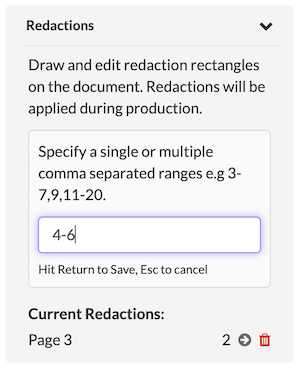
Step 4. Hit the Return key to save your redactions, or the Esc button to cancel the assignment.
Managing Redactions
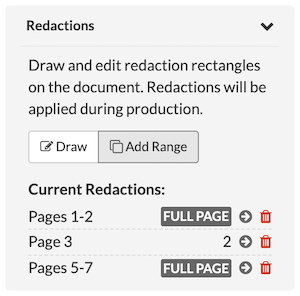
When a document is open in the Document Viewer, you can manage its redactions, with all current redactions listed under the 'Redactions' section in the right panel.
-
Full-page redactions will be marked as such, along with the range of redacted pages.
-
Pages with redaction boxes will be listed (e.g. Page 3 in the image above) and a number will be displayed against them - this is the number of redaction boxes placed on that page.
-
Click on the arrow next to a page or page range to immediately jump to that page/the first page of the range.
-
Click on the trashcan icon against a page number or page range to remove all redactions on that page or in that page range, respectively.
-
To remove a single redaction box -
-
When using the old document viewer layout, click the
Drawbutton, then on theXbutton in the top-right corner of the redaction box. Click onStop Redactingwhen you are done. -
When using the new layout, click the redaction box to be deleted, then click the
Deletetext that appears above it.
-
Applying Redactions during the production process
When producing files, you can choose how to format the applied redactions.
Selecting the Redaction mode
-
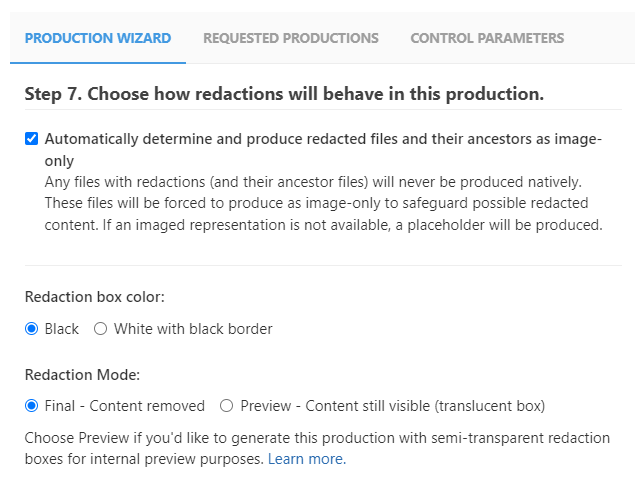
Final Mode will apply standard redactions to the final produced documents, removing all content within the redaction boxes. The boxes become opaque, and the content they cover becomes unreadable and unsearchable. Additionally, all redaction stamps applied to the redaction will be printed on the box.
-
Preview Mode makes the boxes marked for redaction translucent in the final produced documents. The content they cover will remain visible and searchable. (This option is usually used during an internal review as a way to denote what data would be removed if the file was produced using Final Mode redactions.) Also, redaction stamps will not be printed on the redaction boxes in preview mode.
Selecting the redaction box fill color
You can choose the color of the redaction boxes to will be applied to the production.
-
Black boxes
-
White boxes with black borders
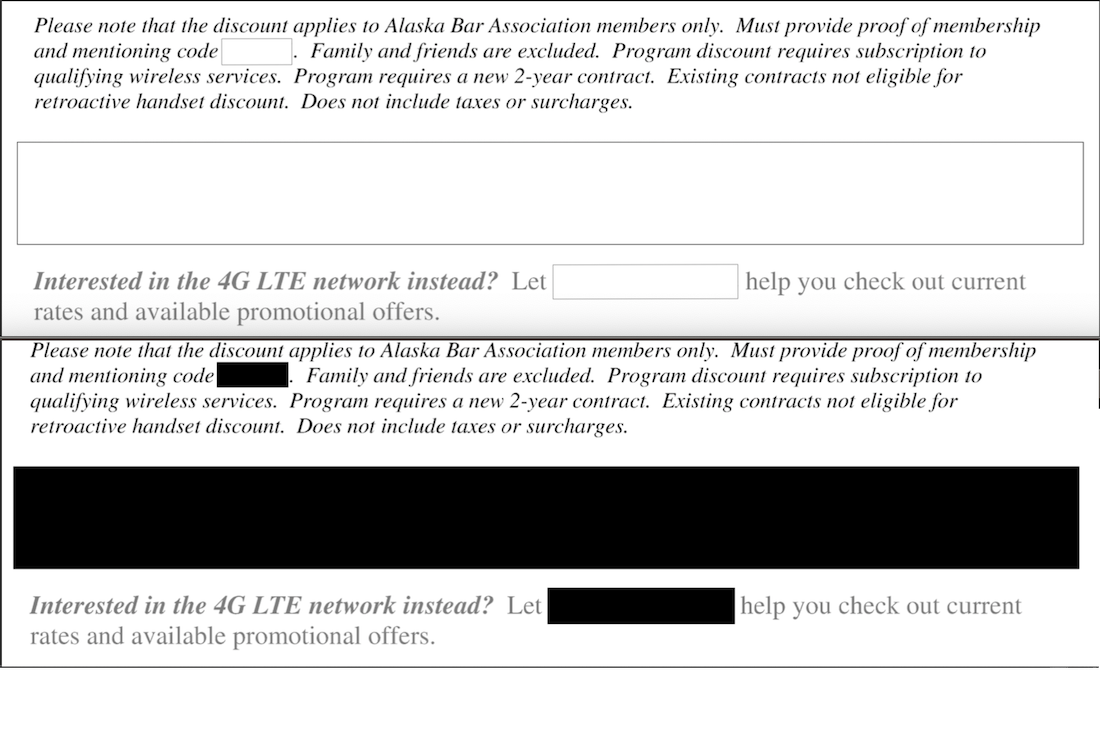
For Preview Mode redactions, the black and white redaction boxes will have their translucent equivalents.
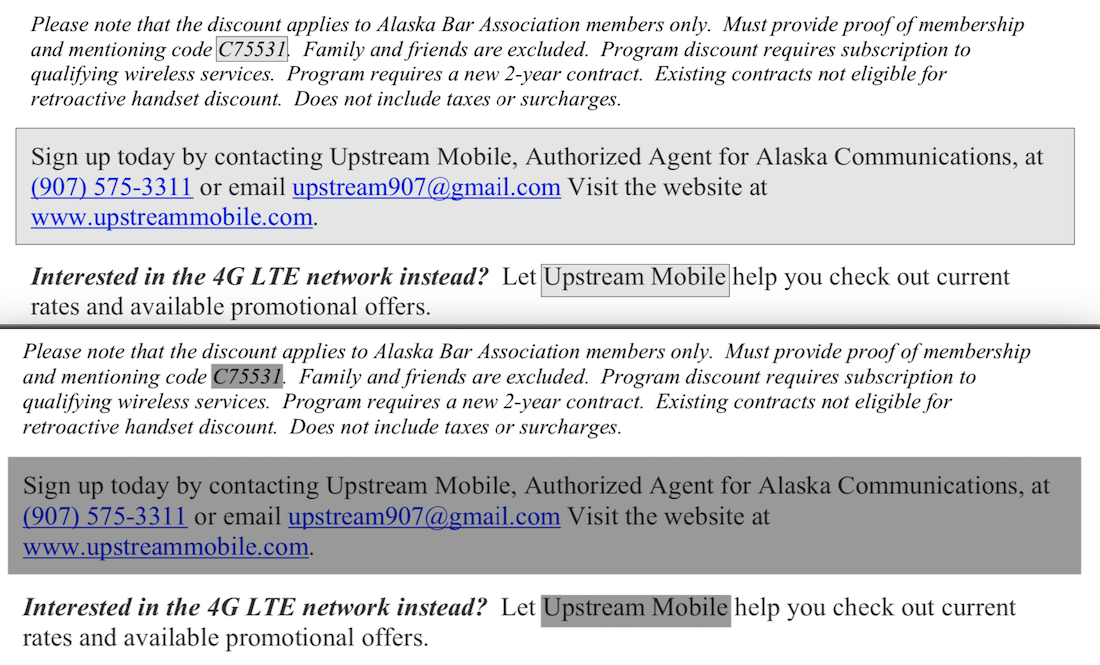
Click here to learn more about redactions in the production process.